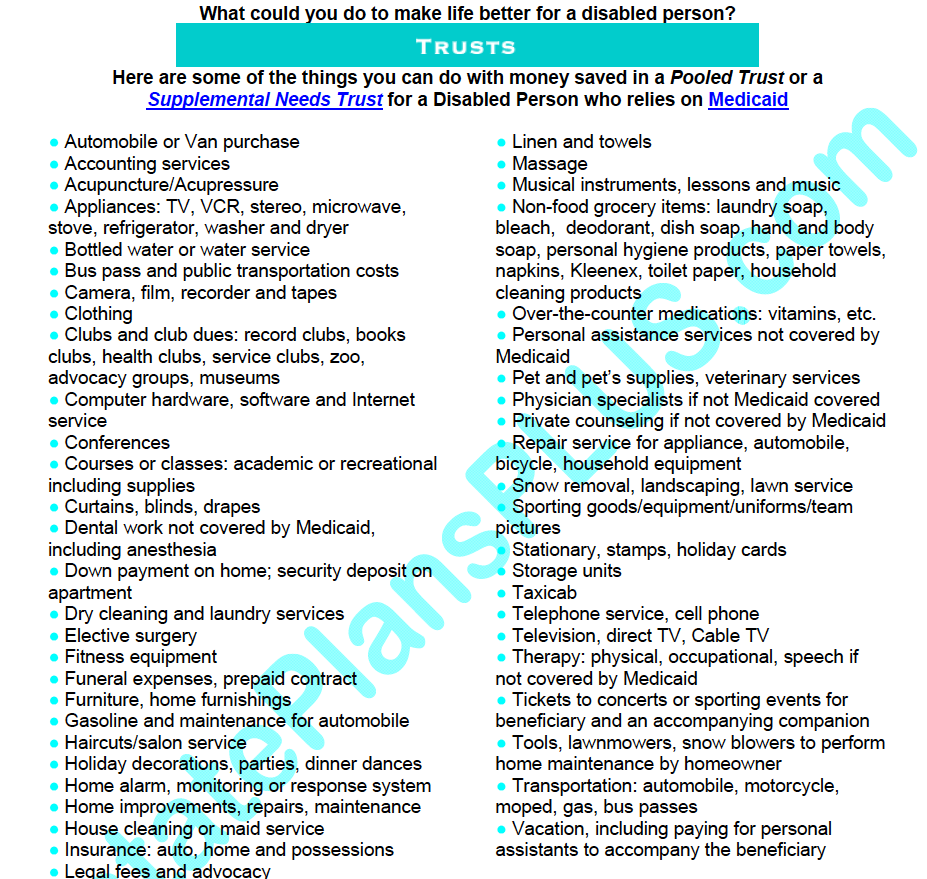
Supplemental Needs Trusts
Client Review: Attorney Roberts worked with me on the estate of a Connecticut resident who intended to leave money for the Supplemental Needs of his disabled daughter . . . Attorney Roberts explained the family’s options for Supplemental Needs planning, and they chose an option that was accepted by the Probate Court.
The most common reason for setting up a Supplemental Needs Trust is the situation where parents or grandparents want to protect and provide for a child or grandchild who has special needs.
To illustrate, let's look at the example of Mr. and Mrs. Avery. They have three children, (A)ndrew, (B)arry and (C)hristopher. The family members are in good health, but Barry has special needs that will always require some extra supervision to protect his best interests. As parents of a disabled child, Mr. and Mrs. Avery have two general choices. They can:

1 - disinherit the disabled child, leave their estate assets to other children or family members, and hope that the disabled child will be cared for in the same way that the parents have cared for the disabled child. This leaves no one legally responsible for properly managing the resources Barry will need. If the disabled child is included in a basic estate plan, this minimal planning can end up disqualifying Barry from disability income and services, and leaves no one in charge of managing Barry's assets and care.
2 - make written plans for the disabled child, including a Supplemental Needs Trust that protects the child's eligibility for disability income and services, and designates a specific person who is responsible to manage the child's assets and care.
Flexibility in Funding the Trust
While the Trust and a designated Trustee are always ready to take charge of unexpected situations, Mr. and Mrs. Avery keep control over their assets during their lifetimes. They are able to adjust the plan for funding the Trust anytime they want to. Understanding the difference between Third Party and First Party (d)(4)(A) Sup Needs Trusts is important.
Read: Pecce case discussed in the video | Pecce case on Google Scholar | Docket
Here are five ways a family could choose to fund the Supplemental Needs Trust:
1. money from their IRA or qualified plan accounts can be directed to the Supplemental Needs Trust. Mr. and Mrs. Avery can adjust the amount of money anytime they want to, simply by sending a new beneficiary designation form to their financial institution. If the Supplemental Needs Trust is properly written, the money can stay tax deferred in the Trust, and Barry's life expectancy can be used to calculate the required distributions.
2. assets can be directed to the Trust, using their wills. Mr. and Mrs. Avery can change the allocation of assets transferred to the Trust upon their death anytime they want to, by updating their Wills.
3. Mr. and Mrs. Avery could fund the Trust during their lifetime with gifts.
4. Mr. and Mrs. Avery or any other family member could purchase life insurance and include the Trust as a beneficiary of the insurance.
5.. Grandparents and other family members can leave money to the Supplemental Trust using their wills or lifetime gifts.
Mr. and Mrs. Avery have peace of mind, knowing that a special plan is in place for Barry. If something unexpected happens to them, they have a person who will step forward and manage Barry's money, and help Barry maintain his independence. Andrew and Christopher will also have the shares of their estate that they designate.
Mr. and Mrs. Avery can designate a family member to serve as trustee, or they can chose a bank trust department to serve as trustee of Barry's supplemental needs trust. The bank will not charge a fee for their services until the bank trust department starts managing Barry's money. They can also chose a charitable pooled trust administrator to hold and manage the trust funds.  Third Party Supplemental Needs Trust administrators comparison chart for Massachusetts and Connecticut.
Using Another Trust to Fund the Supplemental Needs Trust
In another case example, Mrs. Inga Olney chose to protect one of her adult children with a Supplemental Needs Trust. Mrs. Olney is retired, and is a widow. One of her adult children, Bob, lives with her in her home. As a widow, Mrs. Olney has decided to designate a person to manage her assets, in case she becomes unable to do so. In addition to her power of attorney, Mrs. Olney has established an irrevocable trust that will protect her assets. Mrs. Olney has also set up a special needs trust for Bob. Mrs. Olney decided to have her other adult child, Carl, serve as trustee of Bob's trust. While this might not be a good arrangement in most families, Bob has always been close to Carl, and the two brothers have an exceptional level of trust and understanding. She selected a bank trust department as a successor trustee if something happens to Carl.
To fund Bob's Supplemental Needs Trust, Mrs. Olney can use any of the funding methods that Mr. and Mrs. Avery considered. She could also direct that assets from her irrevocable trust be used to fund Bob's Supplemental Needs Trust.